Home › Container Services › Container Delivery
Gooseneck tilt-bed placement anywhere in the metro — with your site qualified from photos before a truck ever rolls.
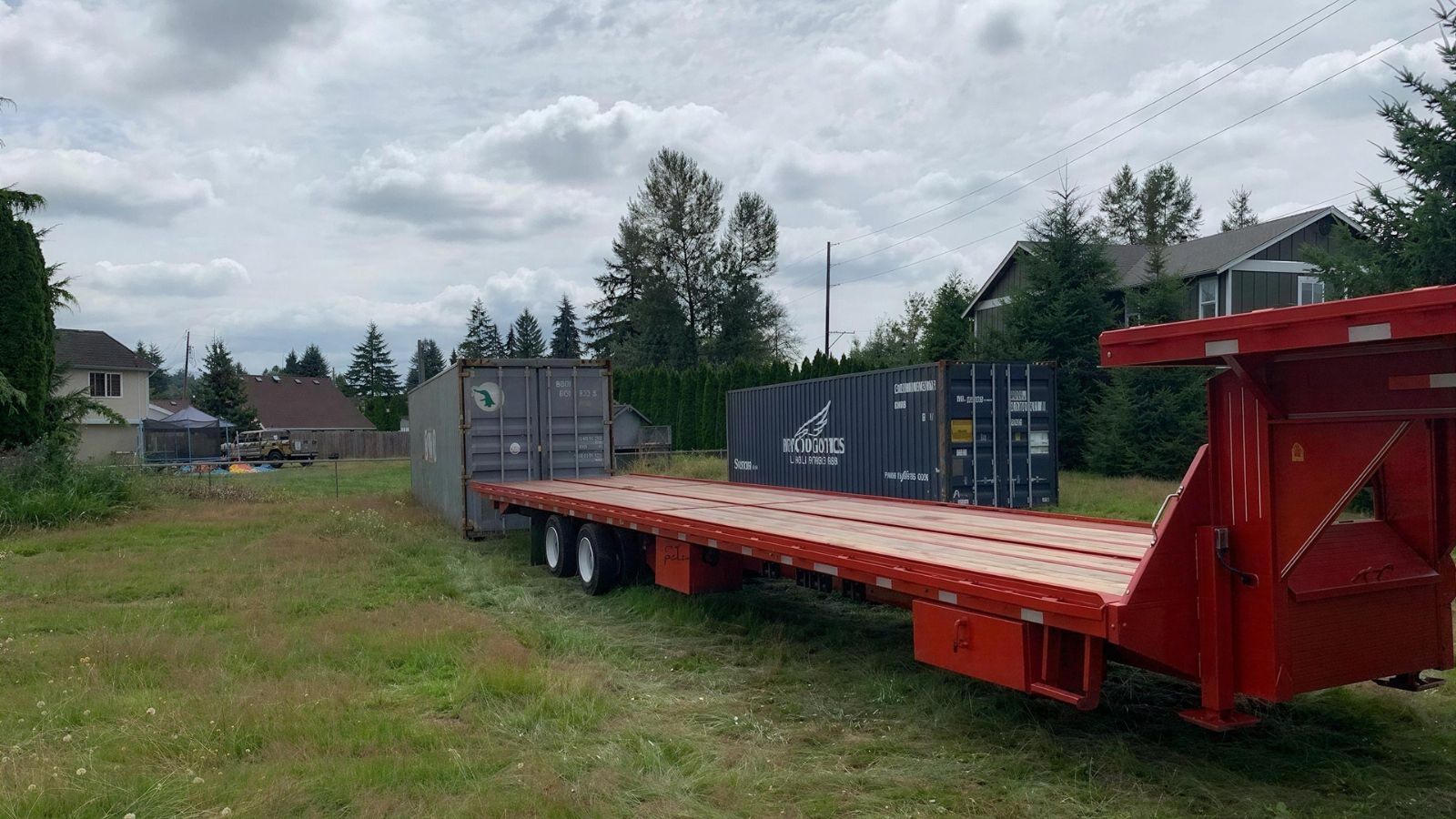
The box arrives on a gooseneck tilt-bed trailer behind a heavy pickup or small tractor. Your driver walks the approach once, lines up, raises the bed, and gravity walks the container down onto your surface as the truck eases forward — placed within inches of your mark, doors facing the direction you chose. Twenty to thirty minutes on a prepared site, no crane, no forklift, no drama.
We deliver the entire two-state metro — Wyandotte, Johnson, and Leavenworth County on the Kansas side; Jackson, Clay, Platte, and Cass on the Missouri side — with the delivery line on your quote scaling with distance from the depot. Close-in areas like KCK and the East Bottoms ride the shortest hauls; exurban drops in Gardner or Grain Valley cost more only because the odometer says so. Every town's real drive time is on its service area page.
Failed deliveries cost you a trip fee and us a schedule slot, so we've made them nearly extinct with a simple rule: tricky sites get qualified from four photos before anything ships — the approach from both directions, the drop spot, and straight up at the sky above it. Send them by text or with the quote form and we'll confirm the plan, flag the wires, or honestly tell you the 40 won't make it and a pair of 20s will.
The logistics team emails a delivery questionnaire within 24 hours of your order, confirms a date within a few days, and most metro deliveries complete inside 10 business days. A paid rush option jumps the queue when a project can't wait.
A straight, level approach — roughly 60–75 ft for a 20ft, 100–120 ft for a 40ft — plus 12 ft of width and about 16 ft of overhead clearance. Firm surface: concrete, asphalt, gravel, or dry compacted ground.
Rain onto pavement, no. Rain onto Missouri clay, sometimes — a loaded trailer will rut soft ground badly, so we'd rather slide a day than trench your yard. Spring storm weeks are the main seasonal variable; we communicate early.
Yes — door orientation is set by the approach direction, so tell us which way you want them when you order and we plan the truck's line accordingly. Changing your mind after placement means a paid re-set, so decide before delivery day.
KC's seasons each write their own delivery rules. Spring is the soft-ground season — clay approaches need a dry stretch, and storm weeks shuffle schedules; pavement-and-gravel sites sail through untouched. Summer is unrestricted, save for coordinating around the road-construction cones that bloom on every metro artery. Fall is peak season — warehouse rows and pre-winter household orders compete for slots, so book ahead. Winter works better than people assume: frozen ground is firm ground, and a cleared approach in January often takes a delivery a muddy March would refuse. Whatever the month, the photo check happens first and the weather call gets made honestly, a day ahead, not in your driveway.
Rows for warehouse fence lines, phased drops for construction sites, paired 20s for households that couldn't take a 40 — multi-unit work is scheduling craft more than trucking. We sequence drops so forklift lanes stay open, orient every set of doors to your workflow, and split large rows across days when your receiving calendar demands it. The delivery fee structure rewards batching: subsequent units on one run carry increments, not full fees. And for operations near the depot's short-haul zone, staged swaps mid-season — trading a standard 40 for a High Cube as the freight mix shifts — stay economical enough to treat containers as adjustable capacity rather than fixed furniture.